Unlock the Editor’s Digest for free
Roula Khalaf, Editor of the FT, selects her favourite stories in this weekly newsletter.
“The arcade,” wrote Walter Benjamin, “is a world in miniature in which customers will find everything they need.”
Arcades are strange. When Benjamin began writing his epic Arcades Project in the 1920s, they had already faded into something anachronistic, a relic of an early modern moment before the architectural gesamtkunstwerk of the department store. There is one moment each year, however, when the arcade sparkles back to life. And it is right now.
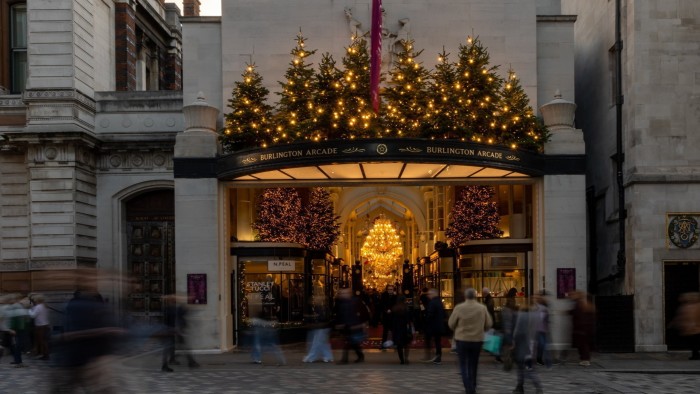
Wander around London’s West End and you’ll see the strings of lights, stars, garlands and illuminated Christmas trees decorating the smattering of remaining arcades; they become enchanted remnants of a very different world when they were a refuge from rainy, muddy, manure-piled streets. The arcades were places where well-dressed men in white spats and women in umbrella crinolines could stroll in safety, under gaslight, illuminated by the dazzle of shop windows.

The reason arcades work so well around Christmas is that they are a hybrid of the street and the domestic interior; the private and the public. London’s look more luxurious now, chi-chi’d in an increasingly Gulf-y sort of way. Burlington Arcade is filled with kitschy chandeliers so it looks like a set for a cheesy Cinderella. Its shops, once a mix of eccentric antiques, silver pheasants and bespoke shoes, now sell overpriced gifts for tourists unfamiliar with financial issues. There is not much here now for Londoners but it still has an appeal, at least as Christmas scenography.
Its roots are very different. Once a public street, George Cavendish, who lived next door at Burlington House (now the Royal Academy), had tired of plebs throwing rubbish into his courtyard so he roofed over the street, in the process creating a fashionable Parisian-style arcade. The small rooms above the shops once housed sex workers. Benjamin’s phantasmagoria and cornucopia were once more comprehensively satisfied. In 1964, a Jaguar sped down the arcade and a gang leapt out to smash in the windows of a silversmiths and steal the jewellery and ornaments. They were never caught and the gates we see now were fitted.
I prefer the less ostentatious arcades: the Royal Arcade off Bond Street, for instance, or my favourite, the Royal Opera Arcade, London’s oldest, designed by John Nash and built 1816-18. What made it so wonderful was its insistent air of incipient failure. There was a slightly shabby Italian café, a few defunct shops among the galleries and it exuded decline. Much like those Parisian arcades that Benjamin wrote about a century ago, these were fading places of wonder which retained traces of all their manifestations from luxury through decay.


It was these same characteristics that appealed to the surrealists. They revelled in the odd juxtapositions inside the arcades, the old signs and the second-hand bookstores, the seedy cabaret theatres and the brothels, the sex and the shopping. Louis Aragon’s book Le Paysan de Paris (Paris Peasant) will celebrate its centenary next year. It centred partly on another opera arcade, this one in Paris (Le Passage de l’Opera), an atmospheric place demolished in 1925. For Aragon and Benjamin these spaces which occupied the otherwise unusable interiors of deep Parisian city blocks acted as a kind of interior life of the outside city, the subconscious of the metropolis. Like the recesses of the mind they held the city’s memories, its forgotten things, its desires and darkness as well as its fragmented sense of possibilities.
The arcades of Paris still retain this sense of a strange undercurrent. Some of the lower-rent passages have been inhibited by strip-lit north African tagine joints and cheap cafés alongside trades almost defunct in London: numismatic and philatelic shops, postcards and prints. They are simultaneously of the past, the present and the future and very much of the about-to-disappear.


London’s attempt to remake its arcades as epicentres of luxury is too clean, too sparkly. You need to go beyond the capital to see something a little more reminiscent of those Parisian dreamscapes. I love Leeds’s Queens Arcade but it has also gone the way of London (the city’s others are a little less chi-chi and better for it). Instead try Cardiff’s warren of almost contiguous arcades (the UK’s closest parallel to Paris). Most of the UK’s cities from Bournemouth to Inverness have fine Victorian arcades which have almost miraculously survived. Most are dying but all are worth seeking out around Christmas, when they evoke the feeling of being inside a shop window and at home simultaneously, their bay windows views into imagined ideal interiors.
It seems to me odd that this remarkable way of making cities has faded out of favour, replaced at first by the department store and then the mall. The small scale of the shops that arcades demand preclude bigger stores, meaning independents stand a chance, or at least try. They are naturally ventilated, unlike stores and malls, and perfectly suited for rainy northern climates, just as they always were. That Prada has colonised a big chunk of the Milan’s Galleria Vittorio Emanuele II, maybe the greatest of all arcades, tells you something. Meanwhile the department stores which replaced them are now themselves in a far worse state.


At an altogether different scale, I love the arcades built into stations like that above South Kensington Tube (always under threat, always still somehow there) or the Art Deco travertine-lined 55 Broadway shopping mall at St James’s Park station. The thriving Leadenhall Market in the shadow of the City’s monster towers is more historic meat market than arcade but it shows how they can thrive if properly looked after. It looks enticingly kitsch right now with its huge Christmas tree and fake snowfalls, the locus of the City’s Christmas celebrations, because no matter how many new glass towers are built, none will evoke Christmas spirit quite like a Victorian meat market. It is a lesson in maintaining these hauntingly perfect and persistently problematic spaces until we know exactly what to do with them. Which is almost always, not too much, please.
Find out about our latest stories first — follow FT Weekend on Instagram, Bluesky and X, and sign up to receive the FT Weekend newsletter every Saturday morning
Leave a Reply