Unlock the Editor’s Digest for free
Roula Khalaf, Editor of the FT, selects her favourite stories in this weekly newsletter.
In the slick recent extension of a Cotswold home, a seven-tonne granite boulder sits boldly in the living room — transformed into a fireplace. Sourced from an Isle of Man quarry, the boulder’s “rear section was sliced to match the curve of the living room wall, vents carved for airflow”, says architectural designer Benjamin Twells, founder of SOTA Architecture. A bespoke steel fire basket means “the fireplace can function while celebrating the beauty of granite”.
Despite being an arresting feature, it “has a calming influence”, says Twells. “It teaches us to slow down; the hearth balances the pace of life.”
While the hearth may no longer still be the heart of the home, its ability to anchor a space, creating a focal point for a room, is tough to replicate. “It’s not just a source of heat, it’s a presence,” says Twells. He’s just one of the many architects and designers reinterpreting the fireplace as sculptural installation.
In a New York warehouse conversion, interior designer David Frazier reworked the fireplace with slices of blackened steel “as a nod to the character of an industrial loft”, he says. The brown and charcoal tones from the blackening process add warmth and keep the design from feeling too stark. At the other end of the spectrum, inside Liddicoat & Goldhill’s recent conversion of an 18th-century threshing barn in Kent, a brick chimney was reborn as a centrepiece that combines fireplace and staircase. “It echoes the idea of the great hall fireplace,” says founding partner Sophie Goldhill.


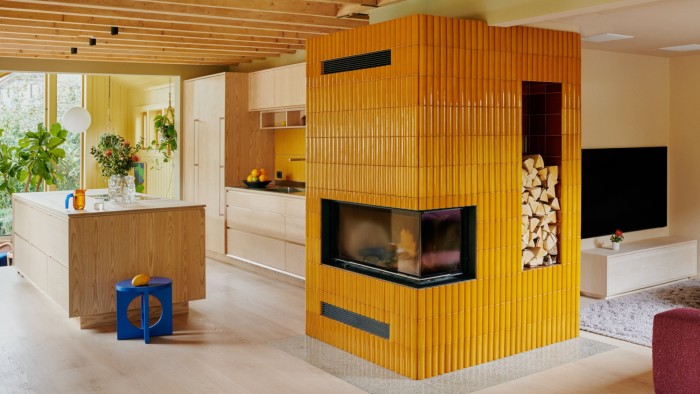
“Even though the fireplace has clean lines and feels modern, we wanted it to carry a sense of history,” says Astrid Bakke Kvistad of Norway’s Kvistad Design Studio, who had a similar approach to the hearth in a 1950s Oslo home. “When we removed the walls around it and relocated the kitchen, it ended up right in the middle of the living space and is now perceived as a focal point.” Its rich, yolk-toned tiles evoke the colours of the era.
In the maple and spruce forests of Ontario, architect Drew Mandel designed a home with a monumental concrete fireplace in its open-plan living room. At almost 10 metres tall, it was cast on site, with a continuous pour into a complex bracework construction to avoid visible seams. “The sheer height and weight of the structure presented a formidable challenge,” he says. The result is more than a visual statement; it is integral to the building’s structure, working as both a central spine and a threshold between living and dining areas.

But Warsaw-based designer Jacek Kolasinski resists spectacle. “People often make the mistake of designing fireplaces that dominate a room,” he says. “I prefer to integrate them with the walls — simple, textured, and calm.” In a 1930s Bauhaus villa by Lucjan Korngold, he created an almost invisible lime-plastered fireplace, whose rounded edges and circular vents, echoing the house’s modernist details, are almost the only clues to its existence. “I generally don’t consider them a source of heat, but a place for the family to gather,” he says.
“In the minimalist 1990s and early 2000s, fireplaces were often erased or downplayed — viewed as quaint or anachronistic,” says restoration expert Owen Pacey. Which means many historic fire surrounds have ended up in salvage yards, including his own, Renaissance London.


“It feels wasteful to chuck something out when, with a bit of creativity, a fireplace can take on an entirely new lease of life,” says Sarah Peake of Studio Peake. “It’s about finding that sweet spot between old and new.” She used tiles from manufacturer Balineum to create a bold monochrome surround for a Victorian fireplace. “I don’t like ripping things out for the sake of it,” she says. Interior designer Rachel Chudley agrees. When renovating a period property, “I always try to complement the original pieces as much as possible.” Chudley, who introduces unusual shapes and materials — such as a bright copper art nouveau-style surround in a recent project — likes to add “a new twist”. “It is nice to see the new hand as well as the old. The easiest way to make a big impression is colour — it is amazing how much a fireplace can be transformed with a little paint.”
Decorative artist Tess Newall is particularly inspired by the fireplaces in Charleston Farmhouse, the modernist house in Sussex. “Duncan Grant and Vanessa Bell adorned them with simple geometric patterns, circles, hoops and crosshatching.” Working with interior designers Kit and Minnie Kemp, Newall has added hand-painted patterns and murals depicting flowers and fruit to projects in London and New York.

We are reaching the end of a period where renovators would block up chimney openings in their period homes, says Pacey. “Thankfully, there’s been a broad return to the fireplace as a design focal point.”
For John Sinclair, whose home Liddicoat & Goldhill worked on, the fireplace has proved transformative. “It makes the barn feel alive,” he says. “When you stand by it, there’s this deep sense of comfort, but also a kind of drama as the flames rise up the central column. Moving around it, the atmosphere shifts, sometimes cosy, sometimes theatrical. It’s what makes the barn truly feel like home.”
Find out about our latest stories first — follow @ft_houseandhome on Instagram
Leave a Reply