Unlock the Editor’s Digest for free
Roula Khalaf, Editor of the FT, selects her favourite stories in this weekly newsletter.
As a child, Fleur Liversidge did not have an attic in her home. So the future interior designer improvised. An upside-down folding chair doubled as the eaves. Layers of blankets added to the eyrie atmosphere of her “make-do” room at the top.
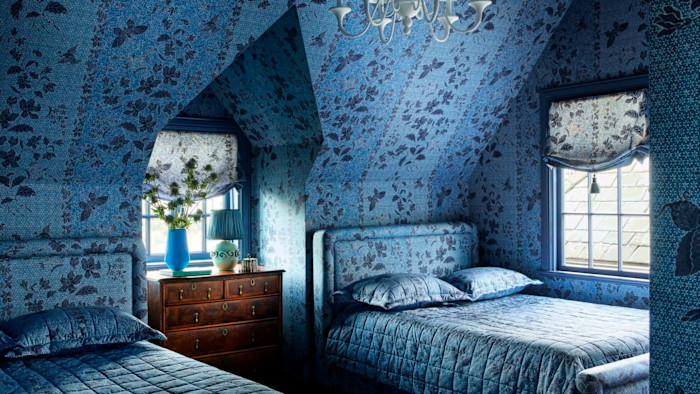
When she was recently commissioned to redesign a 16th-century house in Hampshire, Liversidge looked back to the “cocooning feel” of that DIY hideaway. The attic beams were restored. She commissioned bespoke wallpaper of blossoms to drift across the ceiling as well as walls, to accentuate the “treehouse” effect. “There’s nothing more nested than being in an attic,” she says.
Some designers view the architectural quirks of attic conversions — dormer windows, structural beams, sloping walls — as a problem. Their solution is often to iron out the irregularities: all-over white paint, built-in joinery or false ceilings adding a boxy uniformity.

Others lean into the eaves. Book nooks, fabric canopies (designer Alice Palmer does a flat-pack version), tented wardrobes or Arcadian murals are increasingly used to emphasise, rather than disguise, nooks and crannies, bringing a make-believe feel to roof spaces. Think CS Lewis rather than scary B movie.
“Attics have a particular atmosphere. It’s the light . . . pockets of shadow contrast with the sunlight that comes in through high windows. This makes them challenging — but fun to do up,” says Sarah Peake. Her design devices include tall, sheer bed canopies and hand-stippled walls “to emphasise height”; or beds tucked under low windows and framed by shelves, like a book nook.

“You know what to expect as you move through a period house,” says architect Johnny Holland, of Hackett Holland, whose career began in the 1990s when the fashion for loft conversions was in full swing. “The attic’s different, full of angles and corners. It’s somewhere to experiment.”
Holland advocates a “ship’s cabin” approach, “eking out every square inch, making the most of the attic’s quirky aesthetic”. In the children’s room of an 1820s terraced house in west London, Holland took advantage of the high ceilings to add mezzanine beds with portholes for sleepovers. “An attic of the imagination,” as he puts it.


American designer Summer Thornton agrees. “An attic should transport you.” In the guest room of a gabled Victorian house in San Francisco, matching fabrics on walls and upholstery add to “one cohesive mood”. For Christian Bense, it is all about history. In the children’s room of a country house, he used trunks, rugs, coverlets and deliberately mismatched antique beds to evoke an old-fashioned dormitory.
But while a cast-iron bed adds to the nostalgic, “modest and spare” atmosphere of the attic bedroom in Tamsin Saunders’ west London 1930s cottage, and tongue and groove panelling “accentuates the angles”, the founder of design studio Home & Found also pushes innovative concepts. An en suite has a shower head in the dormer window, “so you can shower under the sky”.
For her 19th-century home in Biarritz, the Spanish designer Marta de La Rica also came up with imaginative solutions to her attic’s unconventional space. Instead of built-in wardrobes, she designed whimsical storage tents dotted around the room, like booths at a fairground. “Fabric became the key to shaping and defining the room,” she says.

“There’s something about taking a smaller, residual space and turning it into something magical that stretches your creativity,” says Scott Maddux. Historically, the top floors of 18th or 19th-century houses had a lowly reputation. They were reserved for unheated servants’ quarters and today can often be dumping grounds for clutter. The Victorian gothic house in north-west London that Maddux renovated felt similarly neglected. His new interiors capture the owners’ Indian roots: there are antiques, a paisley-motif wallpaper and, in the tiny yoga room, a blue-and-white mural by artist Lizzie Porter, inspired by Jaipur’s Bar Palladio.
Art inspired the attic of a collector client of Philip Hooper, joint managing director at Sibyl Colefax & John Fowler. He converted the cobweb-filled attic of a Georgian rectory into a space to display a collection of contemporary ceramics. New dormer windows illuminate the narrow space by day; at night, low lighting creates intriguing shadows in the recesses. Says Hooper: it’s like a modern gallery mixed with the “romanticism of an artist’s garret”.
Find out about our latest stories first — follow @ft_houseandhome on Instagram
Leave a Reply