A required part of this site couldn’t load. This may be due to a browser
extension, network issues, or browser settings. Please check your
connection, disable any ad blockers, or try using a different browser.

A required part of this site couldn’t load. This may be due to a browser
extension, network issues, or browser settings. Please check your
connection, disable any ad blockers, or try using a different browser.
A required part of this site couldn’t load. This may be due to a browser
extension, network issues, or browser settings. Please check your
connection, disable any ad blockers, or try using a different browser.
A required part of this site couldn’t load. This may be due to a browser
extension, network issues, or browser settings. Please check your
connection, disable any ad blockers, or try using a different browser.
A required part of this site couldn’t load. This may be due to a browser
extension, network issues, or browser settings. Please check your
connection, disable any ad blockers, or try using a different browser.
A required part of this site couldn’t load. This may be due to a browser
extension, network issues, or browser settings. Please check your
connection, disable any ad blockers, or try using a different browser.
A required part of this site couldn’t load. This may be due to a browser
extension, network issues, or browser settings. Please check your
connection, disable any ad blockers, or try using a different browser.
Unlock the Editor’s Digest for free
Roula Khalaf, Editor of the FT, selects her favourite stories in this weekly newsletter.
In 1929, Julius Beer, co-owner of the Berson rubber company, bought a sizeable plot of land in the Viennese neighbourhood of Hietzing and began making plans for an ambitious new home. The Beers, a family of wealthy industrialists, weren’t out of place among the other residents in this affluent corner of the capital. But rather than plumping for one of its many art nouveau mansions, Beer envisioned a sleek modernist house that pushed the boundaries of contemporary architecture. For this, he turned to Josef Frank and Oskar Wlach.
The architects had worked mostly on social-housing projects and had only designed a handful of private homes – of which Villa Beer would be by far the largest. The house was completed just three years before the ascent of Nazism and an increasingly antisemitic climate forced Frank, who was Jewish, to emigrate to his wife’s native Sweden. It was in Scandinavia that the colourful textiles and furniture he designed for Svenskt Tenn, the Stockholm home-furnishings company, would secure his name as a leading figure in midcentury design. But in the early 20th century, Frank was known for his buildings: he had represented Austria at the first meeting of Le Corbusier’s International Congress of Modern Architecture in 1928.

Frank had very clear ideas about domestic architecture, and especially this project. “A well-organised house should be laid out like a city, with streets and paths that inevitably lead to squares from which traffic is excluded, so that one can rest there,” he wrote in 1931. Unlike Le Corbusier, who famously described the home as “a machine for living in”, Frank’s brand of modernism prioritised individual comfort over standardised functionality. Villa Beer encapsulated that philosophy, with sculptural staircases, cosy nooks tucked away within open-plan spaces and vast floor-to-ceiling windows that filled the house with natural light.
The Beers moved into their futuristic home in 1930, but didn’t stay long. Financial troubles meant Julius became unable to pay back the hefty loans he had taken out to fund the project. The family was forced to let the house after only 18 months, and in 1938 it was seized by the bank before passing into new hands.


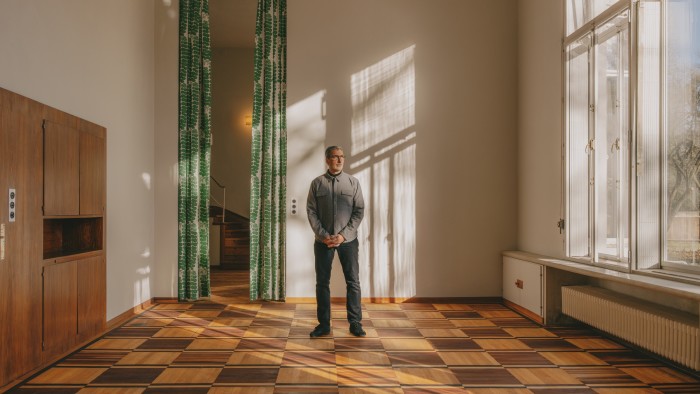
Despite having grown up just around the corner from Villa Beer, Lothar Trierenberg knew nothing of its history. A tall, silver-haired man in his late 50s, he became intrigued by Josef Frank in 2020 when he moved into an office space in the designer’s former home. The next year, a serendipitous Google search revealed that Villa Beer, having stood empty for a decade, was on the market. But Trierenberg decided it should be made publicly accessible rather than be used as his own private home, and established a foundation from his family’s paper-making business for the purpose of maintaining the building, one of only a handful designed by Frank that was ever actually built.
“Although there is a lot of historical substance in Vienna, unfortunately there is little from the modern era,” Trierenberg says, gazing admiringly at the stark concrete façade, bright white against the crisp blue November sky when we meet for a tour. He’s eagerly anticipating the delivery of two 60-year-old Robinia trees arriving from northern Germany – an event that will require the whole street to be closed off. Behind the monumental exterior is a surprisingly modest entranceway, with a series of low-ceilinged hallways and cloakrooms. Trierenberg strolls through them to the vast open-plan living space, taking a beat to admire the late autumn light that floods through the bay window across several floors and a striking grand staircase.

Trierenberg was no stranger to the design world. But without any prior experience in restoring historic buildings, he assembled a team of specialists. Local architect Christian Prasser was called in to lead the restoration work, while Katharina Egghart was recruited from Vienna’s Museum of Applied Arts as managing director of the newly established Villa Beer Foundation. In 2024, after three years of intensive research into the history and fabric of the building, the restoration process began.
From artisan woodworkers to dry-stone wallers, specialists from across Austria were called in to perform precise repair work. As we move through the house, Trierenberg points out details with wide-eyed enthusiasm: radiators sent to Poland to be repaired; new copper windowsills given a special patina so they would resemble the originals as closely as possible; marble slabs that have been returned to their position in front of the fireplace after being discovered in the garden, where they were used as paving stones.


Anything that could not be preserved has been remade with exacting precision. Window panes were produced in Germany using the same techniques from the 1930s; custom rubber flooring was manufactured in Italy to achieve the correct shade of green and offset Frank’s favoured white walls; and tiles for the bathroom and terrace were reproduced by small factories in rural Austria. Trierenberg takes particular delight in the light switches, which have been 3D-printed to match the originals. “Listen,” he says, flicking the switch. “The click sounds just like it would have in the 1930s.” It was important that traces of past inhabitants remained visible. The floorboards, for example, are pockmarked: “I told the carpenters to keep them because they tell the story of the house.” And modern elements have been introduced, namely proper insulation of the roof and basement, solar panels and a geothermal heating system. “It’s a historic building, so it’s important to keep things intact,” says Trierenberg. “But I wanted to improve things from a technical standpoint.”
From March next year, the house will be open to the public for guided tours that will explore not just the architectural significance of the space, but also the history of the Beer family. A small lecture theatre in the basement will host workshops and educational programmes. “It’s an opportunity to talk about the Jewish community, and why they were so important in Vienna during this period,” says Egghart. “Culturally, they really drove the city forward. Klimt and Schiele were supported by Jewish patrons, and they commissioned some of Vienna’s most interesting modernist buildings. They had an open-minded approach to art and architecture that allowed progressive works to develop.”

Music will also return to the house with the installation of a 1910 Bösendorfer grand piano, similar to the one Julius Beer’s wife Margarethe used to play. She trained as a pianist at Vienna’s conservatory, and Frank designed a special mezzanine nook for her practice. A residency programme is also in the works. The top floor of Villa Beer has been set up with bedrooms for a research and artists-in-residence programme, as well as for visitors. This floor has been furnished by Svenskt Tenn, with each room featuring furniture upholstered in a Frank fabric. “What’s funny is that Frank is now known as one of the fathers of Scandinavian design,” says Trierenberg. “But much of the furniture he designed for Svenskt Tenn was actually created here in Vienna.”
Frank’s early career has been largely eclipsed by his success as a furniture and textile creator. But the revival of Villa Beer shines a light on his architectural legacy. It’s a monument to his conviction that good design should serve the comfort and wellbeing of those who live with it. “That’s what really set him apart from other architects of the time,” says Trierenberg. “He believed that architecture is for people. He humanised modernism.”
Unlock the Editor’s Digest for free
Roula Khalaf, Editor of the FT, selects her favourite stories in this weekly newsletter.
“The arcade,” wrote Walter Benjamin, “is a world in miniature in which customers will find everything they need.”
Arcades are strange. When Benjamin began writing his epic Arcades Project in the 1920s, they had already faded into something anachronistic, a relic of an early modern moment before the architectural gesamtkunstwerk of the department store. There is one moment each year, however, when the arcade sparkles back to life. And it is right now.
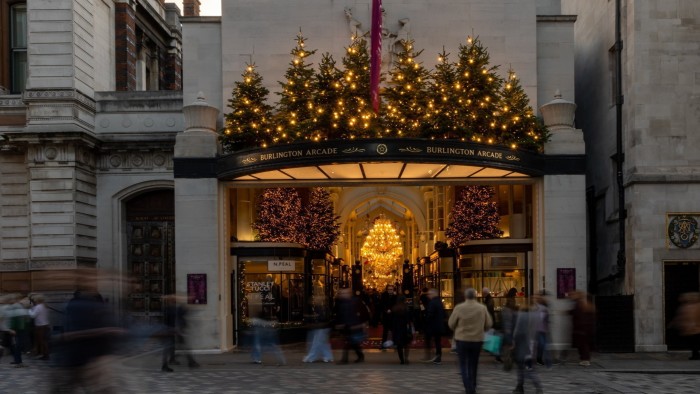
Wander around London’s West End and you’ll see the strings of lights, stars, garlands and illuminated Christmas trees decorating the smattering of remaining arcades; they become enchanted remnants of a very different world when they were a refuge from rainy, muddy, manure-piled streets. The arcades were places where well-dressed men in white spats and women in umbrella crinolines could stroll in safety, under gaslight, illuminated by the dazzle of shop windows.

The reason arcades work so well around Christmas is that they are a hybrid of the street and the domestic interior; the private and the public. London’s look more luxurious now, chi-chi’d in an increasingly Gulf-y sort of way. Burlington Arcade is filled with kitschy chandeliers so it looks like a set for a cheesy Cinderella. Its shops, once a mix of eccentric antiques, silver pheasants and bespoke shoes, now sell overpriced gifts for tourists unfamiliar with financial issues. There is not much here now for Londoners but it still has an appeal, at least as Christmas scenography.
Its roots are very different. Once a public street, George Cavendish, who lived next door at Burlington House (now the Royal Academy), had tired of plebs throwing rubbish into his courtyard so he roofed over the street, in the process creating a fashionable Parisian-style arcade. The small rooms above the shops once housed sex workers. Benjamin’s phantasmagoria and cornucopia were once more comprehensively satisfied. In 1964, a Jaguar sped down the arcade and a gang leapt out to smash in the windows of a silversmiths and steal the jewellery and ornaments. They were never caught and the gates we see now were fitted.
I prefer the less ostentatious arcades: the Royal Arcade off Bond Street, for instance, or my favourite, the Royal Opera Arcade, London’s oldest, designed by John Nash and built 1816-18. What made it so wonderful was its insistent air of incipient failure. There was a slightly shabby Italian café, a few defunct shops among the galleries and it exuded decline. Much like those Parisian arcades that Benjamin wrote about a century ago, these were fading places of wonder which retained traces of all their manifestations from luxury through decay.


It was these same characteristics that appealed to the surrealists. They revelled in the odd juxtapositions inside the arcades, the old signs and the second-hand bookstores, the seedy cabaret theatres and the brothels, the sex and the shopping. Louis Aragon’s book Le Paysan de Paris (Paris Peasant) will celebrate its centenary next year. It centred partly on another opera arcade, this one in Paris (Le Passage de l’Opera), an atmospheric place demolished in 1925. For Aragon and Benjamin these spaces which occupied the otherwise unusable interiors of deep Parisian city blocks acted as a kind of interior life of the outside city, the subconscious of the metropolis. Like the recesses of the mind they held the city’s memories, its forgotten things, its desires and darkness as well as its fragmented sense of possibilities.
The arcades of Paris still retain this sense of a strange undercurrent. Some of the lower-rent passages have been inhibited by strip-lit north African tagine joints and cheap cafés alongside trades almost defunct in London: numismatic and philatelic shops, postcards and prints. They are simultaneously of the past, the present and the future and very much of the about-to-disappear.


London’s attempt to remake its arcades as epicentres of luxury is too clean, too sparkly. You need to go beyond the capital to see something a little more reminiscent of those Parisian dreamscapes. I love Leeds’s Queens Arcade but it has also gone the way of London (the city’s others are a little less chi-chi and better for it). Instead try Cardiff’s warren of almost contiguous arcades (the UK’s closest parallel to Paris). Most of the UK’s cities from Bournemouth to Inverness have fine Victorian arcades which have almost miraculously survived. Most are dying but all are worth seeking out around Christmas, when they evoke the feeling of being inside a shop window and at home simultaneously, their bay windows views into imagined ideal interiors.
It seems to me odd that this remarkable way of making cities has faded out of favour, replaced at first by the department store and then the mall. The small scale of the shops that arcades demand preclude bigger stores, meaning independents stand a chance, or at least try. They are naturally ventilated, unlike stores and malls, and perfectly suited for rainy northern climates, just as they always were. That Prada has colonised a big chunk of the Milan’s Galleria Vittorio Emanuele II, maybe the greatest of all arcades, tells you something. Meanwhile the department stores which replaced them are now themselves in a far worse state.


At an altogether different scale, I love the arcades built into stations like that above South Kensington Tube (always under threat, always still somehow there) or the Art Deco travertine-lined 55 Broadway shopping mall at St James’s Park station. The thriving Leadenhall Market in the shadow of the City’s monster towers is more historic meat market than arcade but it shows how they can thrive if properly looked after. It looks enticingly kitsch right now with its huge Christmas tree and fake snowfalls, the locus of the City’s Christmas celebrations, because no matter how many new glass towers are built, none will evoke Christmas spirit quite like a Victorian meat market. It is a lesson in maintaining these hauntingly perfect and persistently problematic spaces until we know exactly what to do with them. Which is almost always, not too much, please.
Find out about our latest stories first — follow FT Weekend on Instagram, Bluesky and X, and sign up to receive the FT Weekend newsletter every Saturday morning
Every two years, all 350 employees of Snøhetta, the Norwegian architecture and design company founded in 1989, are invited to come together and climb the remote Norwegian mountain that gave the firm its name. At a little over 2,260 metres, the mountain is not especially high by Norwegian standards, but it is symbolic; Vikings believed it was the paradisiacal resting place for warriors killed in battle, Valhalla. For Snøhetta’s employees — from across eight offices on four continents — this biennial climb is a way to show their respect for nature.
“This love for nature is in our DNA,” says Markus Baumann, senior architect at Snøhetta Oslo. “The dream hike for most Norwegians is to spend the day in the mountains and not meet one other person. In our design work, that translates into how our buildings let people experience nature. We want to make [it] accessible but also want to ensure that we make minimal impact possible upon it. It’s a duality that requires balance, to allow people to experience nature but not to destroy it.”
The ethos is becoming ever more apparent in the company’s work in some of the world’s coldest and most undeveloped locations. And while Snøhetta is accustomed to breaking new ground with community-focused projects — a futuristic mountain refuge for hikers in the French Pyrenees; Europe’s first underwater restaurant, in Norway; Lascaux IV, an immersive museum inspired by the French cave paintings; and concert and cultural halls from Shanghai to Prague — many of these new projects are for residential buyers.

“Architecture . . . succeeds when buildings talk and respond to their environment, and that is Snøhetta’s starting point,” says Jeremy Rollason, head of Savills Ski. In the mountains, he says, buyers are increasingly looking for design that “creates a symbiosis between the buildings and their surroundings so that they can enjoy both. That feeling that while you are cosy inside, a vast glass expanse allows you to feel as though you could reach out and touch the wildlife.”
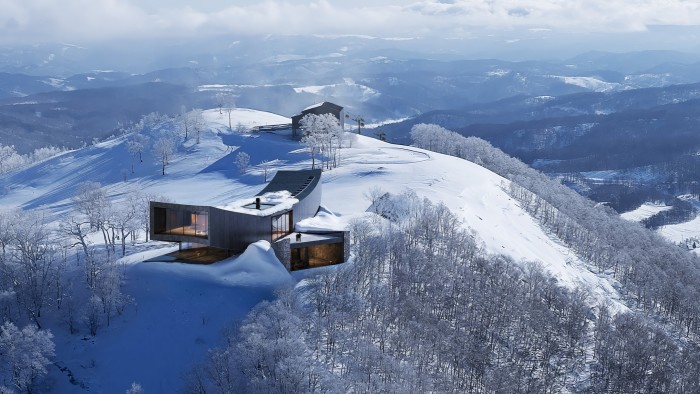
At the top of Rusutsu ski resort in Japan, a co-ownership holiday home for Japanese property company Not a Hotel throws traditional chalet tropes to the wind. Two “wings”, constructed from locally sourced wood and stone, sit on top of each other, curving softly at their midpoint as though bowing in homage to majestic Mount Yotei. Eight bedrooms, a meditation bath carved into stone and an open-air infinity pool fulfil the design promise of bringing residents into nature. Scheduled for completion in 2029, it opened for sales earlier this year — prices start at $7.6mn.
The design builds upon an earlier snowy project on the edge of Dovrefjell National Park in Norway: the Wild Reindeer Pavilion, completed in 2011. This appears the simplest of buildings, a rectangular steel frame with wooden seating shaped like eroded rock and a wall of glass to view Europe’s last wild reindeer herds.

Further south, on Norway’s west coast, 40 minutes from Stavanger, The Bolder was commissioned by a Norwegian entrepreneur, and completed two years ago. It has four compact cabins that appear to hover mid-air, each with a glass facade overlooking the waters of Lysefjord and the pine-covered mountains. “Each cabin is 40 or 50 sq m, but the large windows make them feel more spacious,” says Baumann. “They’re constructed from locally sourced lightweight timber and each stands on a single concrete column, the only thing touching the ground. At the end of their lifespan, you remove the cabins, remove the column and the rock is as it was before.”
“Norwegians have always been closely connected to nature but traditionally, architecture was driven by function, climate and natural resources — not design: how do you shelter from the wind or hinder the snow blocking the front door?” says Cathrine Vigander, adjunct professor at Oslo School of Architecture and Design, and managing partner at architectural firm Element. “Snøhetta was a frontrunner because the company was founded with landscape as the driver, giving equal importance to landscape and architecture; architecture and interior design. For the company, humans are connected to nature, not isolated from it.”
That outlook on luxury — opulence trumped by tranquillity, a sense of wellbeing and connection to nature — is currently being transposed to Switzerland. The Alpinist is a five-star condo hotel with 164 residences launching for sale in the new year in the ski resort of Andermatt (prices from around SFr1mn/$1.25mn for a studio suite). Designed by Swiss architects Nau2 and Holzer Kobler, with interiors by Snøhetta, and currently under construction, it’s a step change in aesthetics for a resort where newly built apartments are attracting particular attention from international buyers. The first few months of the year alone drew more than 1,260 inquiries from US investors.

“The brief was to make the spirit of The Alpinist that of a modern explorer, someone from an urban background but with a deep pull to nature,” says Snøhetta interior architect Julia Lackner. “The design had to find the balance between city refinement and bold Alpine simplicity. The entire ground floor, a huge space, is imagined as an indoor landscape divided into different zones inspired by the exterior landscape: the rocky Alpine terrain, the soft green valleys, forested slopes, gentle meadows and flowing rivers.”
A gently arching ceiling creates a sense of movement that mirrors the rise of the mountains, while the terrazzo floor is inlaid with regional stone to make a pebble-stone path. Andeer, a green stone from the canton of Graubünden, is used to mimic rugged rocks. The lack of ornamented surfaces or patterns is designed to let the natural materials dominate, says Lackner.


The apartments are all warm timbers and soft curves. “A cabin-like refuge . . . your own bubble,” says Lackner. “The colours in the apartments are influenced by leaves in autumn, how the sun hits the mountains and how shades of green shift throughout the year.”
“Snøhetta proved it could creatively marry our aim of a landmark hotel and residences, artistic design and a meeting place for Alpine enthusiasts,” says Russell Collins, chief commercial officer at Andermatt Swiss Alps. “The spaces have been thoughtfully created to forge a community.”
“Many people like the traditional wood-clad chalet because it’s what they’re accustomed to in places like Gstaad in the Bernese Oberland,” says Rollason. “Introducing architects like Snøhetta, whose interpretation is sympathetic to the traditional village yet pushing the design boundaries for the next generation . . . that’s clever.”
Find out about our latest stories first — follow @ft_houseandhome on Instagram

Trong thế giới giải trí trực tuyến hiện nay, T-Sports đã nhanh chóng phát triển và trở thành một lĩnh vực thu hút sự chú ý của đông đảo người hâm mộ. Cùng với sự phát triển của các nền tảng cá cược trực tuyến như Tx88 , T-Sports không chỉ mang đến niềm vui giải trí mà còn mở ra cơ hội kinh doanh cho nhiều người.
T-Sports Là Gì?
T-Sports chính là thuật ngữ dùng để chỉ các môn thể thao điện tử, nơi người chơi sử dụng kỹ năng và chiến thuật để thi đấu. Tất cả các giải đấu T-Sports đều được tổ chức một cách chuyên nghiệp và có quy mô lớn, thu hút hàng triệu người xem trên toàn thế giới.
T-Sports đã xuất hiện từ cuối thập niên 1990, với những trò chơi đơn giản nhưng đầy cạnh tranh. Theo thời gian, ngành công nghiệp này đã phát triển mạnh mẽ với sự xuất hiện của các môn thể thao điện tử nổi tiếng như League of Legends, Dota 2, và CS:GO. Nhờ vào sự phát triển của công nghệ và mạng Internet, T-Sports ngày nay đã trở thành một ngành công nghiệp trị giá hàng tỷ đô la.
Các Trò Chơi Nổi Bật Trong T-Sports
Sự phát triển mạnh mẽ của T-Sports không thể không nhắc đến những yếu tố sau:

Tx88 Và T-Sports: Mối Liên Hệ Chặt Chẽ
Khi nhắc đến T-Sports, không thể không nói đến Tx88 – một trong những nền tảng cá cược trực tuyến hàng đầu. Tx88 không chỉ cung cấp những thông tin mới nhất về T-Sports mà còn là nơi lý tưởng để người chơi có thể tham gia cá cược.
Tx88 mang đến cho người chơi nhiều dịch vụ cá cược hấp dẫn, bao gồm:

Những Thách Thức Trong T-Sports
Dù T-Sports đang phát triển mạnh mẽ, nhưng vẫn còn nhiều thách thức phải đối mặt. Một trong số đó là vấn đề gian lận trong cá cược. Các nhà cái như Tx88 cần thiết phải có các biện pháp bảo mật chặt chẽ để đảm bảo tính minh bạch và công bằng trong từng trận đấu.
Tx88 đang tích cực hợp tác với các tổ chức xác thực và giám sát các trận đấu để giảm thiểu tình trạng gian lận này. Họ cũng khuyến khích người chơi bảo vệ thông tin cá nhân và không chia sẻ tài khoản với người khác.
T-Sports đã và đang chứng minh sức hút mạnh mẽ của mình trong ngành công nghiệp giải trí trực tuyến. Với sự tham gia của nhiều nền tảng cá cược như Tx88, việc trải nghiệm T-Sports trở nên dễ dàng và thú vị hơn bao giờ hết. Dù còn nhiều thách thức phía trước, nhưng với sự phát triển không ngừng, T-Sports sẽ còn tiến xa hơn nữa trong tương lai. Hãy cùng chờ đợi những điều thú vị đang diễn ra trong thế giới T-Sports này!
